PUTTING MONEY IN THE REGISTER
- It may seem strange, but the number of cash handling errors you make may be related to how you arrange your money in the cash tray.
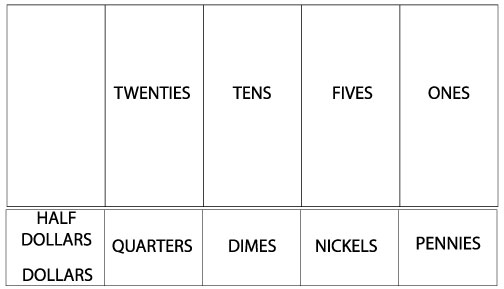
- Arrange it in the cash register carefully as shown in the figure below.
- Place any checks you receive during the day under the cash tray in the cash drawer.
- Make sure all bills are placed in their respective compartments, facing up in the same direction.
- Make sure while putting the bills in the tray that they do not stick together. If the bills are new, it is a good practice to turn the corner down on each bill to prevent giving two instead of one for change.
- Large bills such as $50 or $100 should always be placed under the money tray and taken back to the office safe when you have an opportunity. Also, don’t let excess $20 bills pile up in your drawer… more than about $200 should be moved to the office safe, also.
- Keep coins in their own compartments, with pennies on the right, then nickels, dimes, and quarters. Half dollars or dollar coins should be kept together in one compartment next to the quarters.
- Before ringing up your first sale of the day you should make certain the area around the cash register is clear. Do not clutter the area surrounding the cash register with signs, notes, or other items.
TAKING THE CUSTOMER’S MONEY
- Most errors happen during the exchange of money between the customer and the operator of the store.
- Before you actually take the money, ring up each item the customer is purchasing separately on the cash register.
- Do not try to add the total price of more than one item in your head. The cash register is designed to do this for you.
- Complete each transaction before thinking about starting another one. This will prevent confusing yourself and the customer and will avoid any shortages or overages in the cash register.
- Apologize to the customer who must wait. The better you manage your customers, the fewer errors you will make in handling money.
- Count the money as you receive it from the customer for each sale. Repeat out loud the amount of money handed to you, as well as the amount of the sale. By doing this for every sales transaction, you avoid the chance of becoming confused if the customer should claim that a larger bill was given to you. For example, as the customer hands you this money, you should say, “Thank you, that will be $4.35 out of $5.”
- Leave the amount of money received on the change plate until you count the change from the till. (Don’t stick it in the slot, yet)
- If someone interrupts you or you forget, you will have the exact amount received in front of you just below the row of keys on the register. You will not have any doubt or mistakes on the amount.
- Count the change twice, first as you take it from the till and second as you give it to the customer.
- Start counting your change from the amount rung up until you build up to the amount received. For example, if you have to ring up $4.35 out of $5, you would pick up a nickel and a dime from your till and count aloud, “four thirty-five, four forty, four fifty,” and then pick up two quarters and count aloud, “Four seventy-five, five dollars.” Repeat in the same way as you count the change into the customer’s hand.
- If you or the customer finds an error in your count, take back all of the change from the customer. Make your corrections, and then count the change correctly into the customer’s hand.
- Now remove the money from the change plate and put it in the cash drawer.
- Be sure to close the cash drawer after every transaction; never work out of an open cash drawer.
- If your cash register provides a receipt, tear the receipt off and give it to the customer.
MANAGING THE SAFE IN THE OFFICE
- Excess large bills – $20’s, $50’s and $100’s should be placed in the top drawer (overflow) drawer of the office safe… along with the Daily Credit Card Summary.
- Don’t spend a lot of time organizing and sorting the bills in the overflow drawer. It will be counted during the deposit process so don’t worry about it. Just stack things neatly so nothing can escape from the drawer when opened.
- The “Change” drawer has a fixed amount of money in it. Never take money from the change drawer without “buying” it. If you need ones, put in $25 and take out $25 in ones (a full bundle) – double count it.
- The money is usually rubber banded in the following manner: $25 in ones; $100 in fives; $250 in tens; and $500 in 20’s… these full bundles should have two rubber bands on them. If you take anything out of a full bundle (double-banded), take one rubber band off so that we know that it’s not a full bundle.
- One dollar bills may be further banded together by placing four $25 bundles together to make $100. Twenty dollar bills may be further banded by placing four $500 bundles together to make $2,000.
- If a bundle of bills has two rubber bands on it, it should be in those quantities listed above. If a bundle has a single rubber band on it – this means that it’s not a full bundle… it has less than the quantities listed above. Full bundles, with two bands, are usually kept towards the back of the drawer on top of the quarters and dimes; and partial bundles, or loose bills, are kept at the front of the drawer on top of the pennies and nickels.
- As with your cash drawer, including double-banded bundles of money, keep all like bills together, face up with the presidents all facing the same direction. This will make it much easier to count and to spot an incorrect bill in a bundle or pile where it doesn’t belong.
- The money is usually rubber banded in the following manner: $25 in ones; $100 in fives; $250 in tens; and $500 in 20’s… these full bundles should have two rubber bands on them. If you take anything out of a full bundle (double-banded), take one rubber band off so that we know that it’s not a full bundle.
Keep both the inner safe door and the big outer safe doors closed with the T-handle latched when you are not at the safe handling money.