MONEY AT THE REGISTER
- It may seem strange, but the number of cash handling errors made is related to how money is arranged in the cash tray.
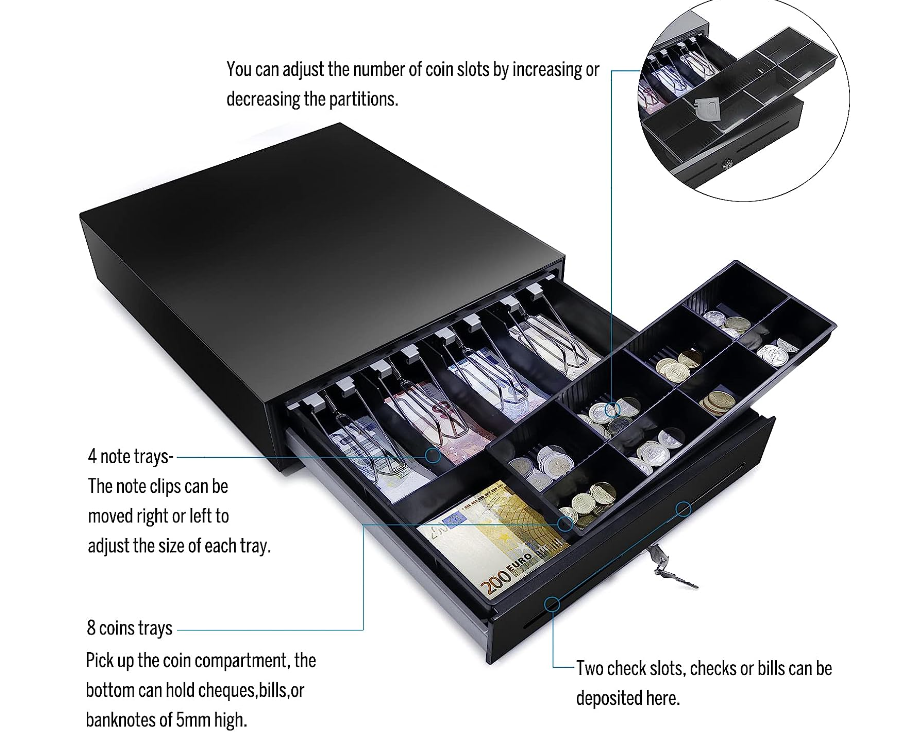
- Arrange it in the cash tray carefully as shown in the figure below.
- Place any checks you receive during the day under the cash tray in the cash drawer.
- Make sure all bills are placed in their respective compartments, facing up and facing the same direction.
- Ensure that the bills in the tray do not stick together. If the bills are new, it is a good practice to turn the corner down on each bill or place older, worn bills between new ones to prevent mistakenly giving out two instead of one for change.
- Do not keep extra bundles of ones or fives in the cash drawer. Wait until you are down to around 5 or less before getting another bundle from the safe.
- Large bills such as $50 or $100 should always be placed under the money tray and taken back to the office safe when you have an opportunity. Also, don’t let excess $20 bills pile up in your drawer… more than about $100 should be moved to the office safe when you have a few moments. If you have $80-$100 of twenties available you can break a $100 dollar bill. More than that should be taken to the safe and placed in the overflow drawer.
- Keep coins in their own compartments, with pennies on the right, then nickels, dimes, and quarters. Half dollars or dollar coins should be kept together in one compartment next to the quarters.
- Excess rolls of coins are not necessary in the cash drawer… more than a roll worth of coins in the drawer is untidy and difficult to control. Excess coins in the tray cause longer count times, at deposit time, and more mistakes become likely. Do not open a new roll of coins until you are on the verge of needing more individual coins for change.
- Before ringing up your first sale of the day you should make certain the area around the cash register is clear. Do not clutter the area surrounding the cash register with signs, notes, or other items.
MANAGING THE SAFE IN THE OFFICE
- Excess large bills – $20’s, $50’s, and $100’s should be placed in the top (overflow) drawer of the office safe.
- Don’t spend a lot of time organizing and sorting the bills in the overflow drawer. It will be counted during the deposit process so don’t worry about it. Just stack things neatly so nothing can escape from the drawer when opened.
- The “Change” drawer (second drawer down) has a fixed amount of money in it. Never take money from the change drawer without “buying” it. e.g. If you need ones, put in $25 and take out $25 in ones (a full bundle) – double count it.
- The money is usually rubber-banded in the following manner:
- $25 in ones
- $100 (20 individual bills) in fives
- $250 (25 individual bills) in tens, and
- $500 (25 individual bills) in twenties
- One dollar bills may be further banded together by placing four(4) $25 bundles together to make $100. Twenty dollar bills may be further bundled by placing four(4) $500 bundles together to make $2,000.
- If a bundle of bills has two(2) rubber bands on it, it should be in those quantities listed above. If a bundle has a single(1) rubber band on it – this means that it’s not a full bundle… it has less than the quantities listed above. Full bundles, with two bands, are usually kept towards the back of the drawer on top of the quarters and dimes; and partial bundles, or loose bills, are kept at the front of the drawer on top of the pennies and nickels.
- As with your cash drawer, including double-banded bundles of money, keep all like bills together, face up with the presidents all facing the same direction. This will make it much easier to count and spot an incorrect bill in a bundle or pile where it doesn’t belong.
- The money is usually rubber-banded in the following manner:
Keep both the inner safe door and the big outer safe doors closed with the T-handle latched when you are not at the safe handling money.